


Among late 19th century German art dealers, the term ‘kitsch’ sprang up to denote artworks that were cheaply-made, unsophisticated and pretentious. The word stuck. A century later, the French polymath Abraham Moles redefined kitsch as “the art of the counterfeit”, a form of ersatz culture that distorts genuine artistic expression through poor imitation.
I’ve been thinking a lot about kitsch because I keep seeing examples of it in my professional environment. Not in the world of art, that is to say, but in the world of education. Kitsch education likewise takes the form of crude mimicry or gimmickry, and it irks me more than kitsch art ever could. In this post I’ll share some some examples of what I’ve come to think of as critical thinking kitsch. I’ll also say something about Philosophy for Children kitsch. Then in my next post, I’ll illustrate academic writing kitsch. I think it’s important to recognise these metaphorical plastic flamingos and leopard skin rugs when we encounter them ‘in the wild’. It’s a first step holding thinkers, writers, educators and students accountable for producing authentic work.
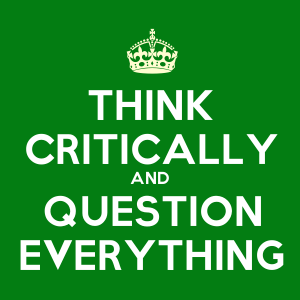
My example of critical thinking kitsch is the popular admonishment to ‘question everything’. The fact that this phrase has been adopted as a slogan of the QAnon movement, notorious for outlandish conspiracy theories, reveals the vast chasm between questioning everything and engaging in genuine critical thinking. Conspiracy thinkers typically apply scepticism only to official or expert explanations; they neglect to test the legitimacy of other sources of information, or their own entrenched beliefs. Philosopher Julian Baggini makes this clear when he writes that “most conspiracy theorists develop an emotional attachment to their theories that blinds them to their obvious flaws.” He goes on to say:
Critical thinking is harder than simply deciding to think for yourself, to question, to test the claims of others… You also need a good character, one that is prepared to be wrong, able to overcome the distortions born of desire, and driven by a sincere desire to understand.
As I’ve previously suggested, genuine critical thinkers are thrifty shoppers in the metaphorical marketplace of ideas. They approach inquiry with a careful balance of open-mindedness and philosophical doubt. This is vital, because true critical thinking consists in so much more than simply adopting a questioning mindset. It involves a broad range of dispositions like intellectual honesty, intellectual autonomy and self-reflection, which serve as guardrails against the pitfalls of ‘truthiness’, wishful thinking, prejudice, and groupthink. Critical thinking also involves a commitment to analysing and evaluating arguments, and applying intellectual standards like clarity, coherence, relevance, and logic. In short, if your questioning doesn’t inoculate you against such nonsense as the belief in a Satanic cabal of cannibalistic child sex traffickers interfering in national politics, then you’re not thinking critically. You might, however, be under the spell of critical thinking kitsch. And this variety of kitsch is not merely irritating but actually maladaptive. It can have dangerous effects, such as violently protesting against purportedly stolen elections—or, in an Australian context, ignoring bushfire evacuation warnings, refusing lifesaving medical treatment, or stalling climate action.
* * *
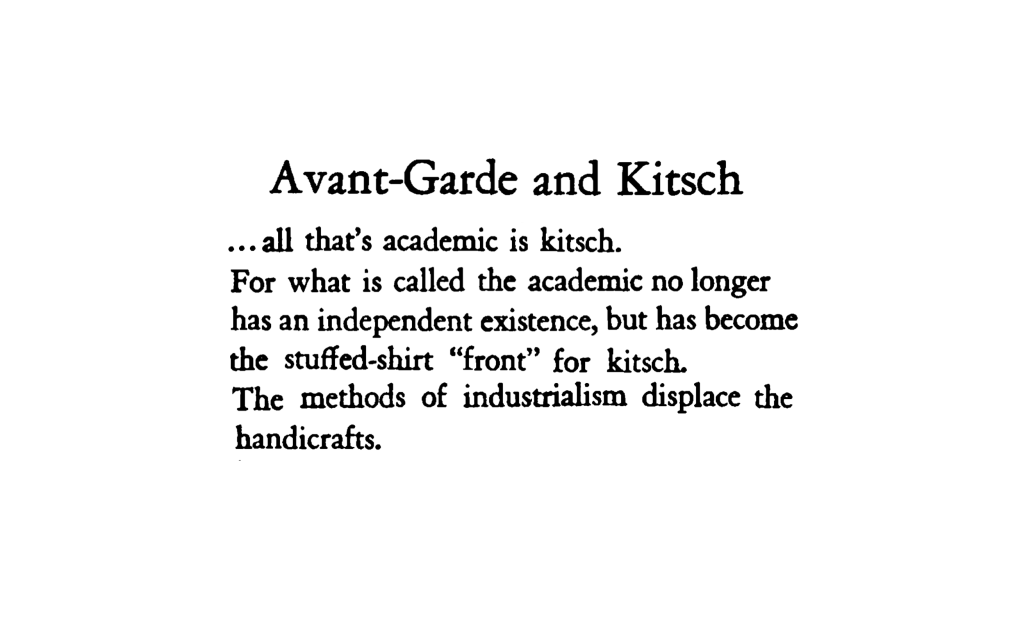
Long before the postmodern embrace of ironic art lent kitsch a new kind of legitimacy, the American art critic Clement Greenberg described kitsch as “deceptive… synthetic art” that feeds parasitically on genuine cultural traditions. Kitsch, he said, is the “debased…simulacra of genuine culture… It borrows devices, tricks, stratagems, rules of thumb… converts them into a system, and discards the rest…. [The cultural tradition] is looted… then watered down and served up as kitsch.” He went on to say, “Kitsch is mechanical and operates by formulas…. Kitsch is the epitome of all that is spurious in the life of our times.”
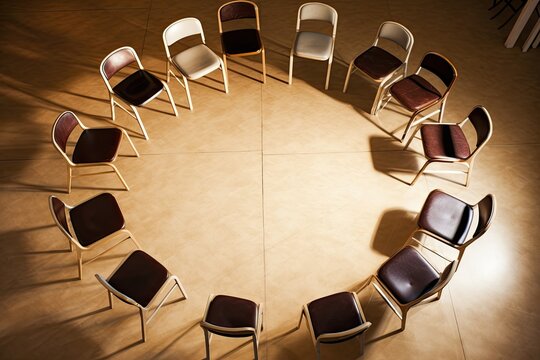
What I call Philosophy for Children kitsch falls into precisely this trap, borrowing devices from the Philosophy for Children tradition and serving them up as a pedagogy. Practice guidelines like this 10-step model risk reducing Philosophy for Children to an exercise of empty ritual, with adherence to procedural norms overshadowing the more meaningful objectives of cultivating genuine philosophical engagement, critical thinking and dialogue. As soon as incidental features of the practice become an end in themselves, pedagogical value evaporates. For instance, the mandate to set up chairs in a circle—as helpful as that arrangement is for facilitating eye contact and group cohesiveness—distracts from what is most at stake.
Expert practitioner Peter Worley remarks that conducting philosophy sessions using the ‘Circle Time’ model “has the consequence that the children often can—and do—choose to discuss questions with no philosophical merit or content”. He also warns against over-interpreting children’s comments “that have a superficial resemblance to a philosophical musing such as: ‘Are we in a dream?’ or ‘What does purple taste like?’”, pointing out that this is mere ‘pseudo-profundity’ rather a mark of philosophical intention. Philosophy for Children practitioners need to move beyond the unsatisfactory limits of the ‘I agree / I disagree’ response model, Worley argues, since taking a critical stance demands more than simply saying ‘I disagree’” (personal correspondence, 15/12/18; for an elaboration, see Worley’s Dissonance: Disagreement and Critical Thinking in P4/wC). His illustrations are useful and worth considering in detail:
Take this example,
A: ‘I think that we should always help each other when we can.’
B: ‘I disagree, I don’t think we should.’
The second speaker (B) clearly disagrees with the first (A), but they are not employing any critical thinking, even if we add a reason:
B: ‘I disagree, I don’t think we should because it’s up to people to help themselves.’
A disagreement may sometimes do nothing other than express a difference of preference or opinion. And, conversely, two people may agree but engage with each other critically. For instance, they may agree that ‘immigration needs to be controlled’ but not offer the same reasons, and they may even think that the other’s argument or arguments offered in support of the claim is or are flawed. What’s more, sometimes the words ‘agree’/’disagree’ are used where they shouldn’t be. For instance,
A: ‘I think Marmite is delicious!’
B: ‘I disagree: I think it’s disgusting!’ ….
Critical engagement is to do with legitimate, dialectic challenges made to one’s reasoning. For example, noticing that one’s argument leads to a contradiction, that the group is working under a questionable assumption, that one has changed the meaning of a word to suit his or her purposes (equivocation), that one’s argument is circular, that it leads to an infinite regress, is self-refuting or that the argument is missing a premise. P4/wC [Philosophy for/with Children], in order to hang on to that ‘P’, needs to be facilitated so that children doing philosophy are not simply encouraged to agree or disagree but to make these kinds of genuinely critical moves and identifications.
Elsewhere, Worley argues that imparting a genuinely philosophical spirit to children requires that they understand the importance of “not merely responding to a problem or question but doing so reflectively and using reason to progress”, as well as being inclined towards re-evaluation. “What is essential to all this is presence of mind”, he says. And demanding our continued presence of mind is part of what distinguishes true philosophy from philosophy kitsch.
……………………………………….
The Philosophy Club, based in Melbourne, works with students and teachers to develop a culture of critical and creative thinking through collaborative inquiry and dialogue.


 The Philosophy Club
Leave a comment