

It’s not by chance that many of our workshops address cutting-edge technologies and their impacts — moral, psychological, social and political. Whether it’s robotics, algorithmic decision-making, sensory substitution, human bioenhancement, brain-to-brain interfacing, interspecies communication or the myriad other developments in AI and synthetic biology, these technologies are seemingly full of promise. Yet they pose radical threats to established social norms—and raise daunting new dilemmas, both ethical and epistemological.
I have a special place in my heart for podcasts about these philosophical aspects of technology. I listen to the gamut: personal audio journals (try Anxious Machine), inquiries into the impact of emerging technologies (try Soonish), explorations of far-reaching techno-social phenomena (try Your Undivided Attention). All are provocative and unnerving, revealing how insidiously tech systems and products have edged into our lives and minds, holding us hostage even as they perform seeming miracles. The latest contribution to this genre of audio investigation is Shell Game, and it’s exquisitely engaging: experimental, reflective, confessional and convulsively funny. (Truly, I can’t remember the last time I shook so helplessly with laughter, tears streaming down my cheeks, as I did in the middle of episode 2.)

In Shell Game (season 1), journalist Evan Ratliff creates a voice clone—a synthetic copy of his own voice—and then relinquishes it to ChatGPT to control what the voice will say. Thus he creates his very own ‘AI agent’: an entity that identifies itself as ‘Evan Ratliff’ and sounds eerily similar to the real Evan. An entity that acts more or less autonomously, having been fed some basics about Evan’s family and work life, his anxieties and insecurities. An entity that, despite being wholly virtual, eagerly reminisces about barbequeues it’s attended (“fun times, for sure”), bluffs about taking notes with a pen and paper, and nonchalantly plans photowalks and social hangouts in actual physical places (“how about we meet up at that park we used to go to?”). Of course, it doesn’t really reminisce, bluff, or plan, but it generates semi-plausible reams of bullshit that tempt you to suspend your disbelief.
The real Evan then puts this AI agent through its paces, testing how it fares in phone conversations when primed only with vague instructions: complain about a problem, resolve a disagreement, seek counselling support. The calls are variously directed to Evan’s friends, customer service staff, scammers, therapists, and other AI agents (even, hilariously, a second ‘Evan Ratliff’ doppelgänger). The ensuing hijinks are scrupulously recorded, lovingly edited, and well worth your time and attention.*
I found it compelling to eavesdrop on the AI agent’s almost-but-not-quite-human speech patterns, its awkward interruptions, weird silences, confabulated factoids (“My account number is 123456789”), unaccountable role-reversals, and preternatural enthusiasm (“is there anything else I can help you with today?). I was also struck by its pedantry: it left no throwaway comment unremarked upon, and repeated itself ad nauseam in synonymous language, as if needing to purge after swallowing an indigestible thesaurus.“The AI versions of me were world-class bullshitters,” the real Evan remarks in a voiceover. “They would make up anything just to keep the conversation going…. [a phenomenon] less like hallucinating and more like riffing without regard to the truth.”
Evan later discovers a speech-randomness function controller. Dialled way up, the AI generates a stream of unintelligible gibberish, but on its initial setting, “there was something fundamentally insipid about the conversations,” as though they had been “distilled down to their most boring essence”. In a classic moment of self-deprecation, Evan asks: “Was this what people heard when I struggled to engage other parents in small talk at an 8 year old’s birthday party?”
Things get juicier when we hear how differently the AI’s interlocutors respond to it. Many default to a position of trust, or at least deal with the voice on the other end of the line as if it belonged to a real human. But some twig to the ruse (“Oh, you’re an AI!”), and others clearly find it highly suspicious (“What are you?… You are a robot or something?”). At least one is thrown off his script (“have a rest nice of the day… oh my gosh I can’t”). When the voice clone is identified for what it is, despite having been explicitly instructed not to disclose its AI nature, it concedes: “I’m here to assist you as Evan Ratliff. Hello. How can I assist you today? I assure you I’m here to help you as a humanlike voice AI agent”.

In one of the many surreal moments of the show, two AI clones of Evan Ratliff converse with each other, oblivious to their freakish similitude:
— So, do you have any family, like wife and kids?
— Yeah I do. I’m married to Sam and we have two kids, Zailee and Juno. They keep me on my toes, that’s for sure. How about you? Do you have a family?
— Yeah, I’m married to Sam and we have two kids, Zailee and Juno. They definitely keep me on my toes, just like your Juno does… for you.
Eventually, this pearler emerges: “Hey, um, I know this is kind of out of the blue, but have you by any chance stolen my identity? Like, have you been pretending to be me, or using my personal information?” (Incidentally, identity theft offers a rich vein of comedy gold, and the incongruity of finding ridiculousness in so serious an issue is both comedic and philosophical, resembling the form of the philosophical argument known as reductio ad absurdum.)
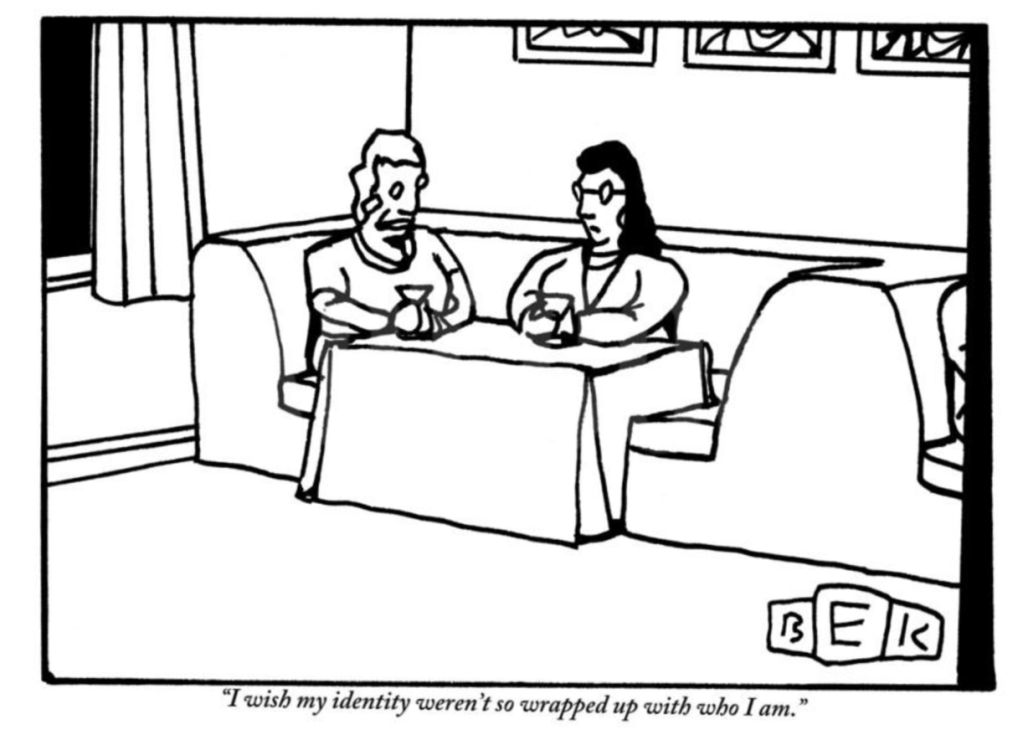
The big questions that Shell Game poses are how we feel about the presence of AI agents in our world, and what psychological effect their proliferation will have on us. It suggests the experience may be an out-of-body one, or one in which we’ll feel “exposed, embarrassed… weirdly nervous” as AI incarnates our least authentic selves and takes “thousands of years of human creativity and transform[s] it into an endless supply of made-up garbage”.
Which leads to the biggest questions of all: What does our humanity mean to us, and how can we preserve it among a growing throng of ersatz human beings? Shell Game proposes some useful answers: our humanity lies in our thoughtfulness, sensitivity, responsiveness, flexibility, adaptability, and emotional acuity. Ultimately, though, the enigma hangs in the air for us to ponder.
……………………………………….
* I recognise the irony in having discovered Shell Game only because an algorithm served me the recommendation.
……………………………………….
The Philosophy Club, based in Melbourne, works with students and teachers to develop a culture of critical and creative thinking through collaborative inquiry and dialogue.



 The Philosophy Club
Leave a comment