

Unless children can think ethically, they won’t be able to behave ethically in a way that’s resilient to outside pressures.
This is the last of three posts in which I share my email conversation with a friend who volunteers as a facilitator in the NSW Primary Ethics program. My friend’s contributions are in blue. I begin with my own reflections.
I think our best hope for guiding children towards ethical behaviour is not to tell them how we think they should behave in any given situation, but rather to give them the tools they need to figure out for themselves how to behave ethically. This means we need to help children develop a range of skills, along the following lines:
- enquiring openly into the meaning and relevance of values, and the concepts and criteria involved in moral judgements;
- thinking clearly and evaluating reasons for and against a moral position;
- empathising with others;
- communicating their beliefs clearly and honestly;
- treating all views (including their own) with some scepticism;
- considering the implications of their actions and decisions;
- developing their own set of personal values;
- making their own judgements about how to behave;
- being ready to revise their judgements if there are good reasons to do so.
Unless children can think ethically, they won’t be able to behave ethically in a way that’s resilient to outside pressures. Of course, it’s one thing for a child to come to a reasoned conclusion about what the right thing to do is in a particular situation, and it’s quite another thing for the child to actually follow through by putting this into practice. There’s a lot of talk about cultivating in children a disposition to act in accordance with their own moral judgements about what is right – but it’s not clear how we can cultivate this, beyond getting children to think deeply about the implications of their behaviour.
Are you saying that the tendency towards morally right behaviour is innate? I would wonder about that… After the innocence of babyhood, humans often head in the wrong direction for many different reasons.
I don’t believe that good moral judgement is innate, but I do think that it naturally develops if children are encouraged to question and to reason – and if, at the same time, they’re encouraged to exercise care and sensitivity towards others. It makes sense to me that within a collaborative, questioning, reasoning and caring community, children will find their own way towards decent, fair and defensible moral positions.
Especially in the early stages, children will need the support of a facilitator and others in their philosophical community to help them learn (and remember) to be sceptical, reasonable and sensitive. But eventually the children will internalise the sort of questions that the facilitator asks. Once they start to ask themselves these questions, they begin to develop a ‘silent dialogue’ – a conversation with themselves – that enables them to test their own ideas independently.
I must say, teaching ethics is an interesting experience for me, having been brought up in the tradition of “Listen to me. I am older and wiser than you.”
I think of myself as a co-inquirer with the children in my Philosophy group. Because I’m older than they are, I’ve had more of an opportunity to develop a coherent worldview than they have. Still, the children occasionally say things that I haven’t considered before – and I want to remain open to the possibility that something a child says might provoke me to reconsider my previously-held views.
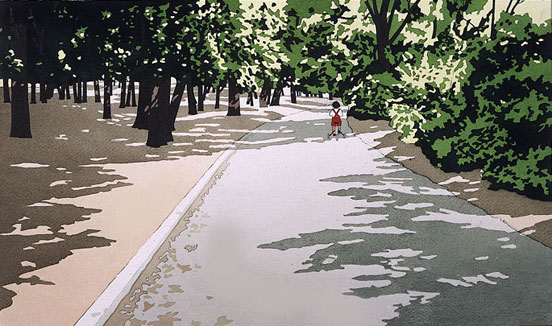
Image above by Yan Nascimbene. Top image by Ilonka Karasz, via Ariel S. Winter.
The Philosophy Club runs extra-curricular workshops for children in Australia.
.



 The Philosophy Club
Leave a comment