
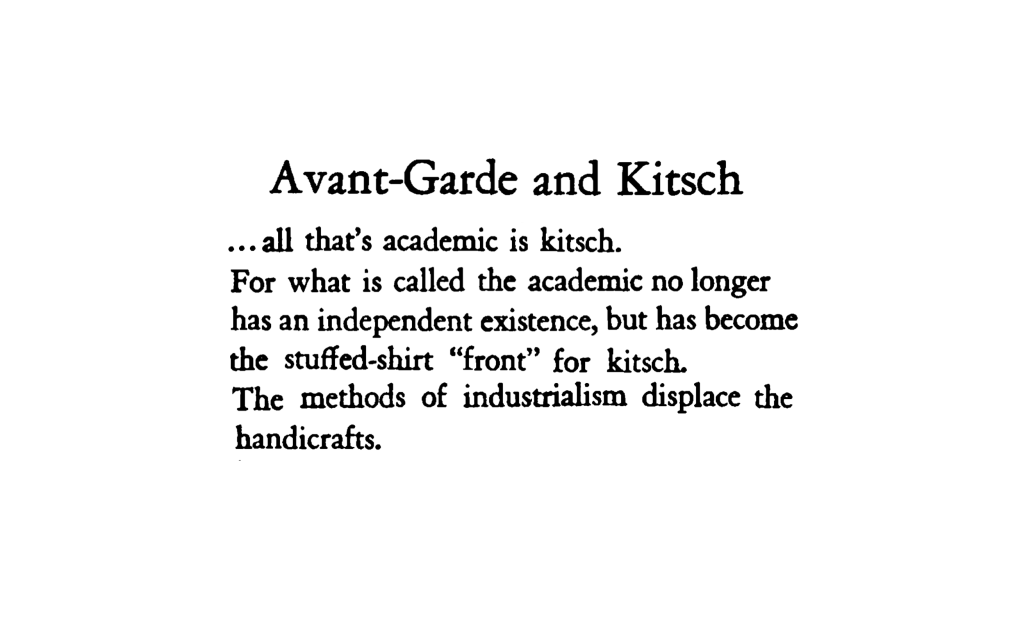
In my last post, I described kitsch art as displaying all the trappings of authentic art without any of the substance. What I’ll call academic writing kitsch is, similarly, the free-floating accoutrements of genuine academic writing.
Academic writing kitsch has many guises. It includes writing that’s needlessly abstract and obscure, and that uses “excessive jargon, neologisms and acronyms; nominalization … and reification; …the use of the passive voice; and grammatical complexity, in the form of endless sub-clauses and qualifications”. This results in the kind of impenetrable and pretentious absurdity on display in the winning entries to the Bad Writing Contest. Here we see academic conventions, taken to an extreme, give rise to formulaic work that stifles the meaningful expression of ideas. Countering this kind of academic writing kitsch, Edward Said has noted that “it’s terribly important as an intellectual to communicate as immediately and forcefully as possible. At some point critics and writers become parodies of themselves.”
Another kind of academic writing kitsch arises from blindly following a formulaic structure without reflecting on its purpose. In essay-writing classes, school students are almost always taught that paragraphs should conform to the TEAL structure (Topic sentence, Example, Analysis, Link to thesis), though I doubt that the rationale for this structure is much discussed.

Karl Maton’s work on semantic waves makes the rationale clear, but in the absence of such understanding we can expect that students will continue to use argumentative language for its rhetorical power without regard to its logical coherence.
Compliance with TEAL alone is never enough to guarantee sound academic writing. This struck me forcefully last week when reading some Year 9 literature essays. One of the students had set out an argument with clear and well-qualified premises, each carefully justified with reference to textual evidence, in perfect compliance with the TEAL model. The recurrent problem I noticed is that she drew overly definitive conclusions. Towards the end of each paragraph, she abruptly shifted tone from tentative to categorical, inserting the word ‘therefore’ before revealing her bold conclusion. ‘Therefore’ was as a verbal flourish that gave the impression of logical implication, just as an magician’s ‘abracadabra’ conveys the illusion of magic occurring.

While this might have been simply an example of weak academic writing, I think it’s helpful to think of it as academic writing kitsch. Why? Because in sacrificing substance to form, it appears to be something it’s not: a truly persuasive text, one that convinces the reader of the credibility and relevance of the arguments and evidence presented.
Kitsch is so pervasive, art critic Clement Greenberg notes, that “[we] must have a true passion for [genuine culture]… [so as] to resist the faked article that surrounds and presses in on [us].” The troubling reality is that our cultural heritage of rational argument is very much endangered, and phoney arguments press in on us from all directions—even, ironically, from our educational authorities. Let’s go meta for a moment, and review a very confused definition of ‘argument’ from the NSW Department of Education’s English K–10 curriculum.

It’s hard to know where to begin with a sentence as convoluted and circular as the one I’ve highlighted in yellow, above. If I can barely parse it, what are students to make of it? One thing we can probably agree on is that arranging words like ‘argument’, ‘reason’, ‘evidence’ and ‘persuasion’ any old configuration, creating a false semblance of coherence, is an egregious example of meta-argument kitsch. It reminds me of Emily Bootle’s astute observation: “The moment you begin to perform authenticity, it becomes meaningless.”
……………………………………….
Other posts you might like:
- Critical thinking kitsch
- The NAPLAN Persuasive Writing test subverts critical thinking
- How to think about a Persuasive Writing task
- Could do better: Exam questions fail
- Boot camp for intellectual virtues
- Critique of a bioethics teaching document
……………………………………….
The Philosophy Club, based in Melbourne, works with students and teachers to develop a culture of critical and creative thinking through collaborative inquiry and dialogue.



 The Philosophy Club
Leave a comment