
A philosophical inquiry into memory, perception and embodiment
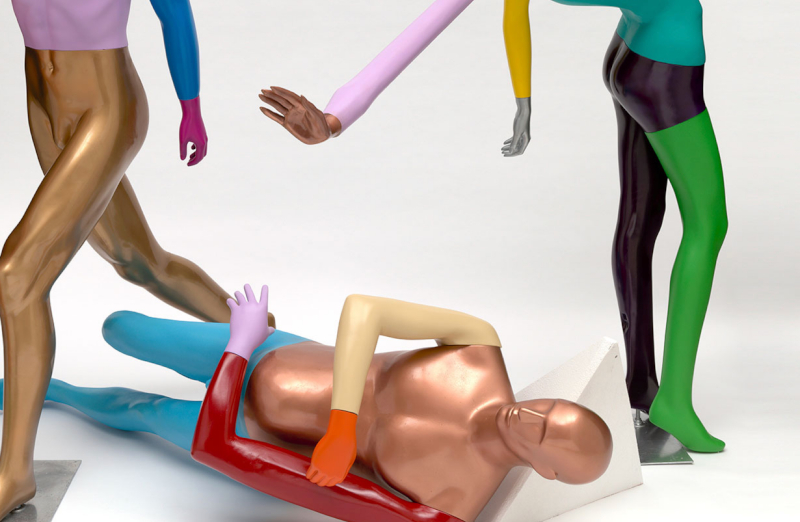
Image from an installation by Justene Williams, via Queensland Art Gallery’s exhibition ‘Embodied Knowledge’
Scroll down for free workshop materials!
This workshop investigates epistemological, metaphysical and ethical questions relating to memory, perception and embodiment. It includes a series of intriguing case-studies including:
- Video clip: Science communicator Destin Sandlin’s experience of learning (and unlearning) how to ride the ‘Backwards Brain Bicycle‘, a bike altered so that when you turn the handlebar to the left, the wheel goes to the right, and vice versa. (When learning how to ride, reliance on muscle memory inevitably causes failure.)
- 19th century psychologist George Stratton’s experiments with learning (and unlearning) how to navigate the world while wearing ‘upside down glasses’: a lens system that inverts images so that everything appears to be upside down.
- Overthinking-related performance blocks (such as the ‘yips’ and ‘twisties’) that cause experts to fumble. (Here, reliance on muscle memory is the solution, rather than the cause of failure.)
- Video clips 1, 2, 3, 4: The anecdotal experiences of various organ transplant recipients who claim to have acquired preferences, emotions, or skills associated with their donors.
- Scientific evidence (albeit limited and controversial) of cellular memory, suggesting that memories from an organ donor’s life are stored in the cells of a transplanted organ, lending some credibility to the notion that recipients may inherit memories or preferences from their donors.
- Video clip: The remarkable phenomenon of the flatworm, which – when cut in half – can not only regenerate a head (including a brain) from its tail region, but can furthermore remember things it learned before it was beheaded.
This workshop tackles questions such as:
- Does ‘knowing’ refer to possessing or applying knowledge?
- What would it be like to share someone else’s memories?
- Could receiving an organ transplant alter a person’s identity?
- Would you accept a heart transplant from a murderer? Is ‘moral contagion’ a rational fear?
- If we entertain the possibility that memories or traits can be transferred through organ donation, should donors be informed about the potential for this to occur? What impact would this have on consent for organ donation?
- How can something without a brain remember anything? Is ‘cellular memory’ a plausible theory? Could memories be distributed to neural tissue throughout the body?
This workshop is informed by the revolutionary work of synthetic biologist Michael Levin. Other academic and popular science sources are cited in the footnotes of the Runsheet (see below).
––––––––––––––––––––––––––––
The following workshop materials are shared under Creative Commons license CC BY-NC-SA (Attribution-NonCommercial-ShareAlike) for all original material. (Materials from other sources are clearly credited in the runsheet.)
- Runsheet – What the Body Knows (100 mins)
- PDF Slides – What the Body Knows (video clips not included – to view video clips, use hyperlinks indicated on the runsheet)
- Printable cards for activity (please guillotine quote cards and heading cards. You may wish to print multiple copies of the quote cards to distribute among various pairs/small groups)
____________________________
This work is available free of charge, so that those who can’t afford it can still access it, and so that nobody has to pay before discovering it’s not what they are really seeking. But if you find it valuable and you’d like to contribute whatever easily affordable amount you feel it is worth, please leave a donation via Paypal below.

In appreciation,
Michelle Sowey
Co-Founder and Managing Director
The Philosophy Club


 The Philosophy Club